
Bimini Fishing - Now is the Time!
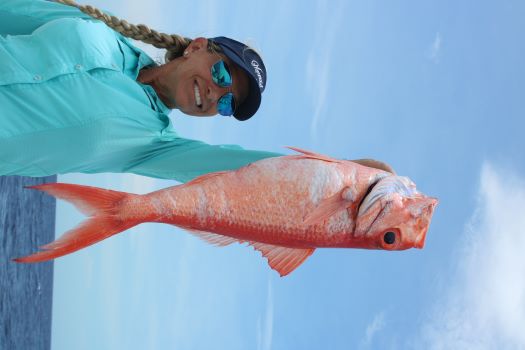
Several scenarios have lined up to make this the perfect time to head to the Bahamas and enjoy a fishing experience of a lifetime: a change in Bahamian policy regarding boating fees; the Atlantic ‘summer calm’ (minus named storms, of course); signs that fuel costs are going to creep back in the right direction; and of course the main event - incredible fishing.
A little more than a year ago, the Bahamas restructured their boating fees for crossing, raising the ‘cruising permit fee’ considerably. By and large, Florida boaters collectively said, “no thanks,” suggesting that the increased boating ‘tax’ was not going to accomplish the initial goal of Increased revenue for the Bahamas.
Dropping the fees appears to be the right move. Last week I crossed with my wife Megan and some friends from Ft. Lauderdale, Bruce Wade and Carole Strickland Wade, and as we hoisted the yellow quarantine flag upon arrival Carol’s eyes were on the Bimini Big Game Club as we passed. “Oh good! There are boats here. Last year when we came across, this place was a ghost town.”
Today, the fees are much closer to the way they were before the hike: a 30-day ‘cruising permit’ for boats under 30’ is back to $150, and 30-50 footers will run you $250. There are other fees to consider – a passenger tax of $30 per person over 5 years old (the first three per boat are free, the tax applies to additional passengers); a ‘tender fee’ if you are towing a boat of $500; a sportfishing permit of $100 if you are going to fish (rates increase with boats over $50) to name a few.
Bottom line, it is cheaper to go now that it was last year, fuel costs aside. If you are considering making the trip for the first time, I recommend checking out this link that will spell out all of your mandatory and optional fees based on the details of your trip: https://www.waterwayguide.com/knowledge-center/news-post/12640/bahamas-boat-entry-fee-calculator-estimate-your-costs-before-you-travel.
 Bruce and Carol are what I would consider frequent Bimini boaters, and Bruce confirmed this when he answered my wife’s query about how many times he has crossed by boat. “Oh, 150 or 200, I would guess…” -Which gave Megan some comfort, considering this was her first ever crossing.
Of course, there are other ways to get to Bimini. Flights run daily from SE Florida, both commercial flights and smaller ‘puddle jumper’ flights. And there is a ferry that zips across on a regular basis, the Baleria, which costs $180 if you can’t find a discount. The caveat is that there are not fishing boat rentals in Bimini, so if you plan to spend time in/on the surrounding water, renting a jet ski or maybe a paddle craft is your only option.
There are a handful of charming local pubs, places to grab a bite to eat, and ‘mom-n-pop’ souvenir shops that make renting a golf cart very worthwhile, not to mention the Dolphin House museum, local beaches to explore, and the chance to drive on the other side of the road for a few days, just to say you have. If you prefer a more posh environment, Resorts World Bimini has modern amenities and a busy little casino.
 Ultimately though, the main reason for making the crossing is the fishing.
I usually gravitate towards the shallow water stuff and have very fond memories of countless bonefish on pristine Bahamian flats. And the pelagic monsters that storm through, from billfish to giant tuna to wahoo and mahi are legendary – just google “Earnest Hemmingway and Bimini” to get an idea. But this trip, and fishing story, is all about the bottom fish, primarily snapper and grouper.
I’ve been on many, many boats with scores of anglers, and can say without question that Bruce is one of the very best. He handles his boat like he was born with a boat key in his hand, and he is “that guy” who always seems to have a bent rod while the rest of us are wondering if our baits fell off.
His boat electronics have many Bimini location numbers that he has amassed over the years, but honestly, he watches the general bottom contours and stops to fish new spots just as often as his old marks. This is encouraging for those of us who will be looking for places to fish.
The bottom over there drops from 40 feet to over one thousand, sometimes incredibly drastically. If you come directly west off Bimini, the drop parallels the shore. Likewise, if you run south a bit, that trend holds. If you run north towards the Isaacs or the Gingerbreads (southern edge of the Northwest Providince Channel), the drop swings to an east-west run. This is key info as you decide where to try to fish each morning, as you want to play the wind and currents to get the best possible drift for bottom fishing.
“Ideally, you would drift along a consistent depth,” said Bruce. “But even in the best-case scenario you will end up moving either up or down the slope at some point, and if you are bouncing baits or jigs on the bottom you want to drift slowly towards deeper water.”
This is true for a couple of reasons. First off, your drifts, and ‘lines in’ fishing time, will be longer if you are running parallel or moving slightly deeper as you drift. Second, opening your bail and drop your bait to find bottom every few minutes is far superior to having to try to reel up the reef, keeping your bait close to the bottom while not getting snagged.

What can you expect to catch in that 150-350 depth range? With Bruce and Carol, here’s some of the species we have caught together: snappers (black, black fin, yellowtail, mutton, schoolmaster and others), groupers (‘red hind’, red, black, yellow-edge, and more), grunts, margates, AJ (greater and lesser), triggers (queen, gray, ocean, and more), hogfish, margate, grunts, ‘cudas, rainbow runners… plus a collection of other incidentals.
You don’t really need to get any fancier than a simple chicken rig, with a six or eight ounce bank sinker on the bottom (depending on drift, wind depth, etc.). 40-pound leader material is our standard. Some prefer spinning reels, some conventional, either works with jigging rods.
Every species listed above can be caught using squid for bait pinned to a circle hook. Cut baits work too, but squids do help eliminate the initial bite being a shark. Speaking of sharks, that is what will likely be the reason you need to move off any productive drift. “Once a shark zeroes in on your fishing boat, they will stay with the boat and keep eating your fish during the retrieve. Trust me, you’ll get frustrated far sooner than they will get full,” Bruce lamented. “Best to pull up and move to the next great spot,” of which there are many.
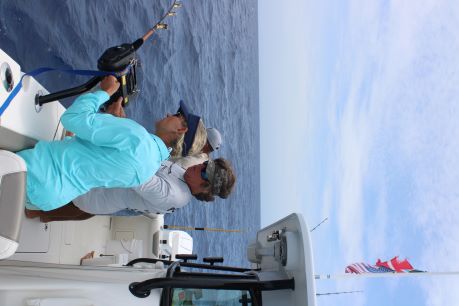
Deep dropping is famously productive off the Bimini coast as well. The concept for getting the best initial drift might be even more important here, because at this depth it is tougher to keep things on the bottom without snagging if you are dragging up the reef instead of parallel or down. Finding newer spots is a little tougher here, but not impossible. 800+ depths will test the limits of your electronics for sure, but if you note a sudden change of bottom contour and have a favorable drift, why not send ‘er down? With Bruce and Carol, we’ve caught queens, wenchman, yellow-eyes and more.
The size weight used for deep dropping varies, depending on depth, wind, current, drift speed, etc. – this is nothing new, so always have an assortment. A variety of hook sizes on your deep drop tackle could come into play, as some of the targeted fish have smaller mouths.
There are Bahamian fishing bag limits to consider, and the word on the water is that they are finally enforcing the limits with more regularity. Each fishing boat, regardless of size, is allowed up to 20 fish in the snapper/grouper complex for the day. This includes the hind commonly known as ‘strawberry grouper‘, but does NOT include grunts, margates or other similar fish. Out of respect for the Bahamian waters, as well as the possibility of paying hefty fines (or worse), staying on top of all local fishing rules and laws should be a top priority.
Crossing to the Bahamas is not for everyone. It requires planning, especially when it comes to safety. Having a boating bud like Bruce, who is a fantastic boat captain with tons of experience, really makes it a lot easier on your stress levels. It doesn’t hurt that Bruce, owns a World Cat boat (he and his biz partner Drew Davis own three World Cat Marine locations in Florida). These hulls have always been a favorite of mine due to their incredible stability and extensive fishable square-footage. That said, as noted early on, we’re entering the time of year that affords high probabilities of calm seas, particularly in the mornings, so long as there is no tropical disturbances in the region, so any well maintained vessel of moderate size and fuel capacity can get the job done.

Your final step in planning a fishing trip like this is anticipating the need for a personal log book. iAngler, owned by us at AAF, is the perfect solution for that because it stores unlimited photos, keeps key details of your fishing info safe behind a password, and can contribute to improved fishing regulations and conservation through our relationships with the different management agencies. iAngler is ready for your use for any kind of fishing trip, anywhere in the world, and it is absolutely free. Many iAngler users leverage the personal log book to improve their fishing success each trip. You can too - download that sucker today and start organizing your personal fishing information, and maybe someday you can become someone’s Bruce!

- Log in to post comments